The Engagement–Lab–Production (ELP) Framework for Continuous Actuation
Traditional organisational structures optimise for stability and control, but struggle under conditions of rapid technological change, uncertainty, and distributed participation.
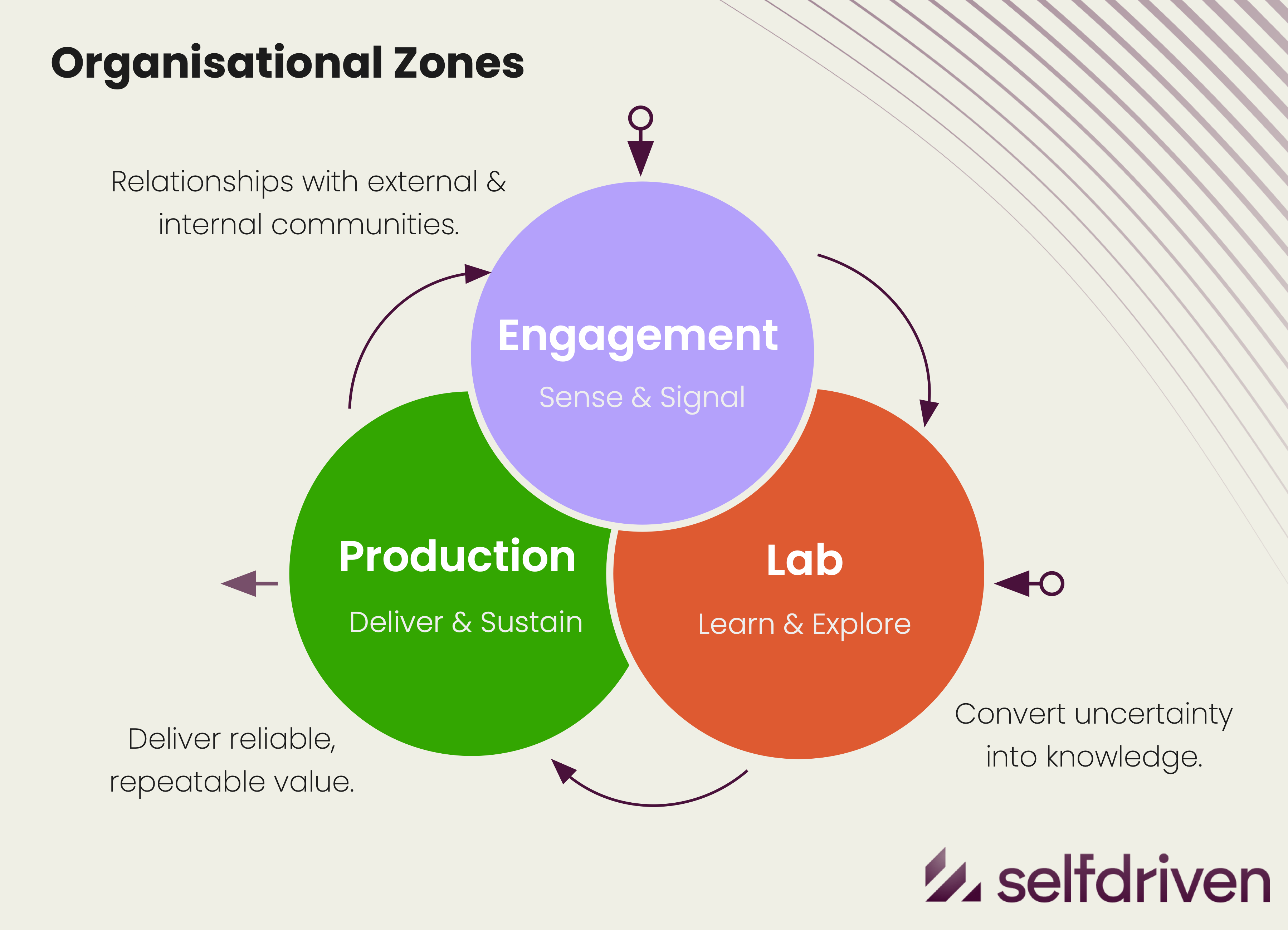
This framework is a simple, resilient organisational model based on three functional domains: Engagement, Lab, and Production. Each domain plays a distinct role in value creation, learning, and delivery, while maintaining clear boundaries to prevent systemic failure. The model applies across corporations, cooperatives, research institutions, communities - any organisation.
The Problem with Traditional Structures
Most organisations collapse incompatible functions into a single hierarchy:
- Exploration and delivery compete for attention
- Public engagement interferes with experimentation
- Innovation is judged by production metrics
- Production is destabilised by constant change
Common failure modes follow:
- Innovation theatre
- Burnout and churn
- Risk aversion disguised as governance
- Premature scaling or perpetual prototyping
A structurally explicit separation of concerns is required.
The Three Zones
[E] Engagement (Sense & Signal)
Purpose
Maintain relationship with the external world and internal community.
Functions
- Stakeholder engagement
- Community, customers, members
- Narrative, legitimacy, trust
- Signal gathering (needs, pain points, opportunities)
Characteristics
- High variability
- Human-centred
- Narrative-driven
- Low irreversibility
Outputs
- Signals and requirements
- Prioritised questions
- Mandates for exploration
Core question:
What matters, to whom, and why now?
[L] Lab (Learn & Explore)
Purpose
Convert uncertainty into knowledge.
Functions
- Research
- Prototyping
- Experiments
- Feasibility testing
- Capability development
Characteristics
- High uncertainty
- Fast failure tolerated
- Loosely governed
- Time-boxed
Outputs
- Validated learnings
- Proofs of concept
- Kill decisions
- Scale-ready candidates
Core question:
What could work, and under what conditions?
[P] Production (Deliver & Sustain)
Purpose
Deliver reliable, repeatable value.
Functions
- Operations
- Manufacturing or software delivery
- Service provision
- Compliance
- Cost control
Characteristics
- Low variability
- High reliability
- Strong governance
- Change-resistant by design
Outputs
- Products
- Services
- Revenue
- Sustained outcomes
Core question:
How do we deliver this safely, repeatedly, and at scale?
Boundary Rules (Critical Interfaces)
Engagement ↔ Lab
- Engagement may request exploration
- Lab informs engagement with evidence
- Engagement must not promise outcomes pre-validation
Lab ↔ Production
- Lab hands over only validated artefacts
- Production rejects unstable work
- No experimentation on live systems
Engagement ↔ Production
- Engagement does not bypass lab
- Production does not negotiate scope directly
- Scope changes route through lab or formal change control
Governance by Zone
| Domain | Governance Style | Appropriate Metrics |
|---|---|---|
| Engagement | Legitimacy & trust | Participation, clarity, signal |
| Lab | Learning velocity | Hypotheses tested, insights |
| Production | Reliability & efficiency | Uptime, cost, quality |
Applying production KPIs to engagement or lab work is a category error.
Scaling the Model
The model is fractal:
- Startups: all three domains in a small team
- Enterprises: domains as divisions
- Cooperatives: domains distributed across member groups
- AI-augmented orgs: agents in lab and production, humans anchoring engagement
Relevance in an AI Era
AI collapses the cost of:
- Ideation
- Prototyping
- Content generation
Without structural separation:
- Engagement floods production with noise
- Labs overproduce unshippable artefacts
- Production becomes brittle or chaotic
This model enables:
- Safe acceleration
- Human legitimacy
- Machine-assisted exploration
- Stable delivery
Summary
The Engagement–Lab–Production model:
- Separates sensing, learning, and delivery
- Preserves innovation without destabilising operations
- Scales from teams to ecosystems
- Aligns naturally with AI-augmented work
This is not a management trend.
It is a structural necessity for organisations operating under continuous change.